Helyszín címkék:
Stone Lions, a Park Revived After a Red Sludge Disaster, and an English Garden Nestled at the Foot of Somló Hill: A Garden-Themed Journey Through Time in the Bakonyalja Region
Hajdú Gábor
What exactly will we be exploring?
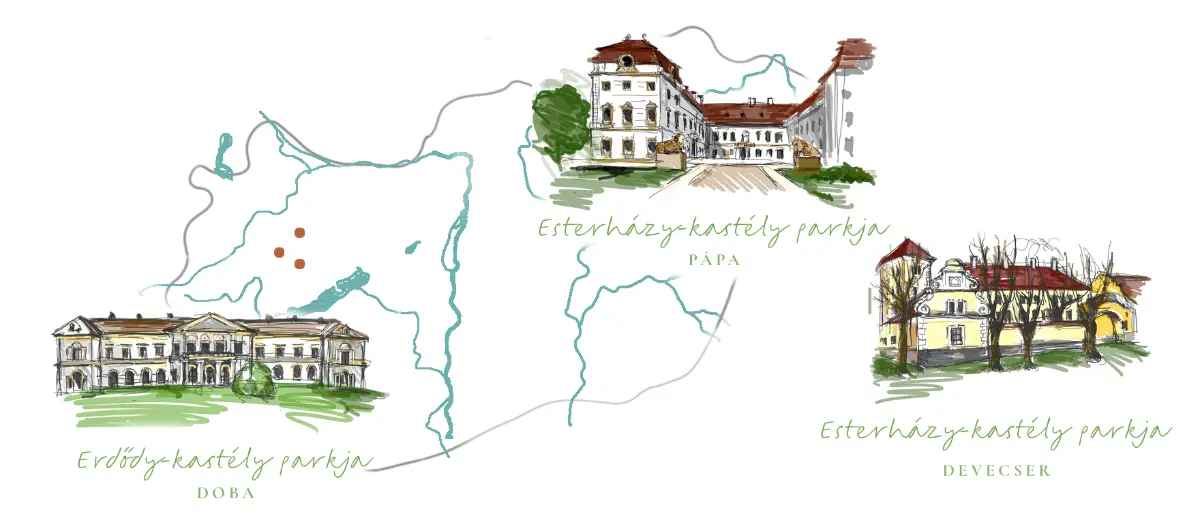
- A Baroque ornamental garden where stone lions guard the gate brought from Paris – Pápa
- A castle park reborn after the red sludge disaster, featuring centuries-old trees – Devecser
- One of Hungary’s largest English gardens at the foot of Somló Hill – Doba
Pápa, the garden of the Esterházy Castle
Evliya Çelebi was the first to write about the garden in Pápa in 1660. He stopped in the town during his travels through Hungary and already at that time wrote with great enthusiasm about the garden’s rare, ancient trees. Around 1730, Ferenc Esterházy commissioned Anton Pilgram to carry out a Baroque reconstruction of the medieval castle; Pilgram’s plans included a Baroque garden, but this was never realized. The marshy area surrounding the castle was not drained until around 1770, following the regulation of the Tapolca Stream and the Bakony Creek. The two streams still adorn the park today, although their former bridges have long since disappeared.
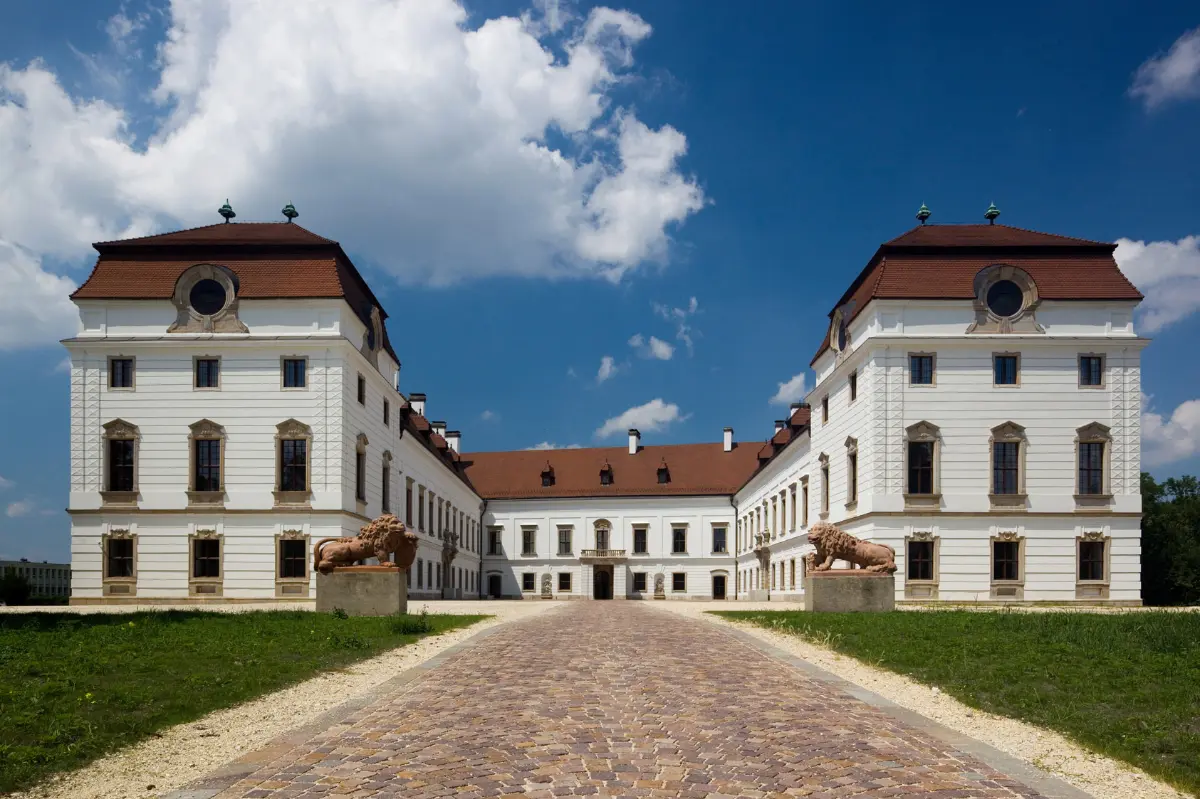
The Baroque castle itself was built between 1783 and 1784 upon the order of Count Károly Esterházy, who later became the Bishop of Eger. The U-shaped building enclosed a courtyard of honour, or cour d’honneur, which overlooked the Main Square and the church standing there. Károly Esterházy also had a sala terrena – a ceremonial hall opening onto the garden – built facing the garden, which by then had been transformed into a landscape garden on the site of the drained lake. We know from contemporary correspondence that the garden also featured glasshouses, greenhouses, and even a grotto (an artificial rock cave).
The two stone lions still visible today were commissioned around 1790; they originally framed an ornate wrought-iron gate. In the 1860s, this gate was replaced with one brought from the Tuileries Gardens in Paris, and the stone lions were first placed next to the wooden bridge crossing the Bakony Stream, and later moved to the ornamental courtyard. Today, the park’s vegetation includes nearly 80 tree species: in addition to native linden, oak, and maple, one can also find exotic species such as the fern pine, the emperor tree, the Japanese pagoda tree, and the cigar tree. The pyramid oak adds a unique touch, while among the conifers, there are stately specimens of the giant and Caucasian pines. The castle now houses a museum, and the park is open to the public.
Devecser: The castle park revived after the red sludge disaster
In the northern part of Devecser stands the centuries-old estate of the Esterházy family, the castle, which today houses one of the country’s most beautiful libraries. The design of the castle park is associated with Károly Esterházy: at the end of the 18th century, he began draining the area north of the castle and then created the Baroque castle park. The main road built at the end of the 19th century – today’s Pápai Street – cut the park in two, thereby reducing its size. In 1890, during the castle’s renovation, the garden was also revitalized: at that time, the area between the castle and the Torna Stream was afforested, and most of the tree groves still visible today were planted then.
Located at the boundary between the flora regions of the Kisalföld and the Bakony, the park is dominated by native floodplain groves and hornbeam-and-English oak forests, though exotic species such as plane trees, horse chestnuts, black pines, and swamp cypresses can also be found while strolling through it.
The darkest day in the history of the castle park occurred in October 2010: following the breach of the Kolontár red sludge reservoir dam, a flood of red sludge approximately one and a half meters deep inundated the park. Through years of work, the area was successfully cleaned of the alkaline, corrosive sludge, and in 2014, Devecser regained its revitalized, renovated castle park.
During opening hours, visitors can view the Renaissance fireplace, door frames, and window frames in the castle’s library, while the inner courtyard features a replica of a Renaissance fountain brought from Italy – the original is now on display at the Museum of Fine Arts. The exterior of the castle and the park are open to the public year-round, while the library is open only during regular hours.
Doba-Somlóvár: One of Hungary’s largest English gardens at the foot of Somló Hill
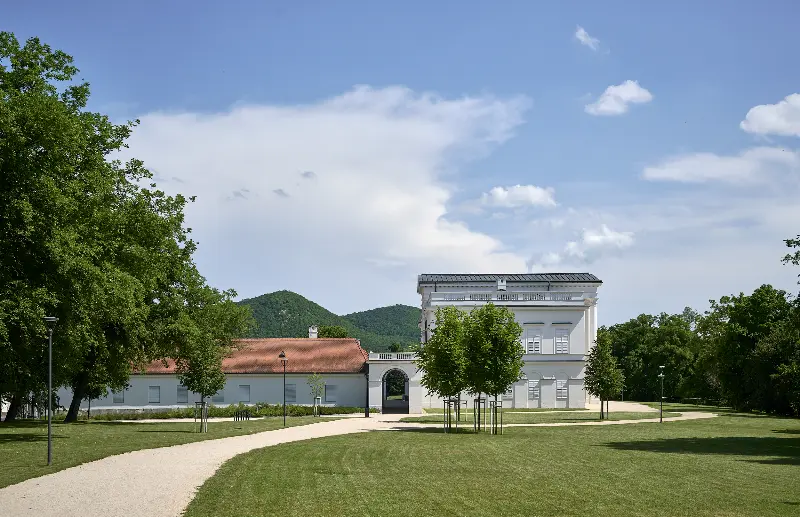
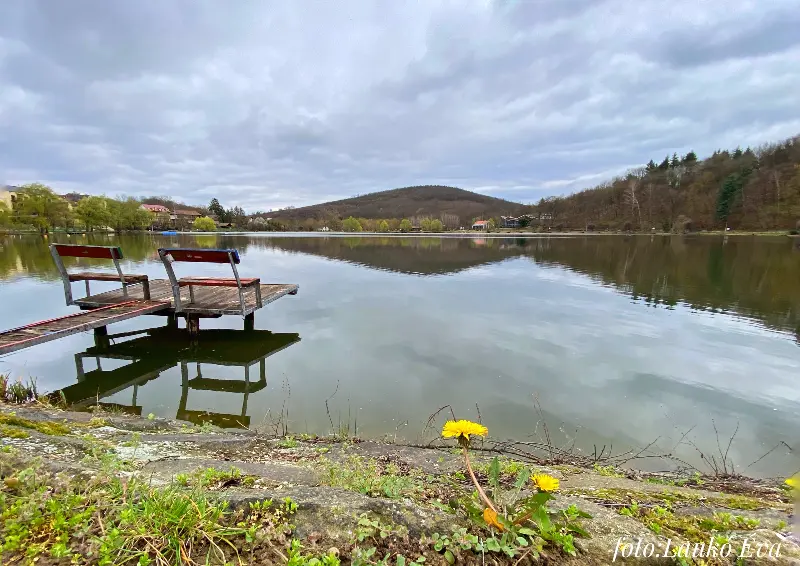
The park of the Erdődy Castle in Doba-Somlóvár, situated at the foot of Somló Hill, is impressive even in terms of its size: the 90-hectare English garden is almost as large as Budapest’s City Park. Wooden gazebos, winding walking paths, a babbling brook, graceful bridges, and the castle reflected in the lake make for an unforgettable stroll. It is no coincidence that in the 19th century it was cited as one of Hungary’s most valuable English gardens, mentioned in the same breath as the most beautiful English and German gardens.
Archbishop Tamás Bakócz bequeathed the estate to his cousins, on which József Erdődy had a castle built on the crest of a hill. In 1836, Kajetán Erdődy – a great lover of plants – commissioned the famous architect Charles Moreau to design the garden in accordance with the principles of classical landscape gardening: with few structures, yet seamlessly integrated into the landscape. The park’s most prominent landscape feature was the large Halastó (Fishing Pond), created alongside the Hajagos Stream, where an island once stood. The garden’s layout was shaped by clearing the existing oak forest, creating three large clearings and long visual axes pointing toward the church tower in Doba, the vineyards of Somlószőlős, and Somló Hill. In addition to native trees, a significant number of exotic tree species were also planted: red oak, laurel-leaved oak, tulip tree, black walnut, and serrated-leaved beech; in the wetter areas, there are alders, willows, tall ash trees, and white poplars. One of the country’s first orangeries was also built here, and the gate pillars of the original stone fence can still be admired today.
The building now houses the István Hollós Sociotherapeutic Psychiatric Hospital, which is why the park – designated a protected natural area – is less well-known to the general public, even though it is open to the public.